
When PG&E and Edison Can't Provide Power: How Solar Solves the Capacity Crisis for Manufacturing and High-Power Businesses
PG&E and Edison don't have enough power to give. Upgrades can take years—sometimes it's easier to buy a new building. Discover how scalable solar systems maximize your roof space and deliver the power upgrade you need, when you need it.
The Power Crisis You Never Saw Coming
You've got a growing business. Orders are up. You need to expand production. Add new equipment. Hire more people. But there's one problem: PG&E and Edison don't have the power to give you.
This isn't a hypothetical scenario. It's happening right now to manufacturing facilities, warehouses, data centers, and high-power businesses across California. The utilities are maxed out. They can't provide additional capacity. And when they can, it takes years—if it happens at all. This is where commercial solar becomes the solution.
Here's the harsh reality: Sometimes it's easier to buy a new building than to get more power added to your existing one.
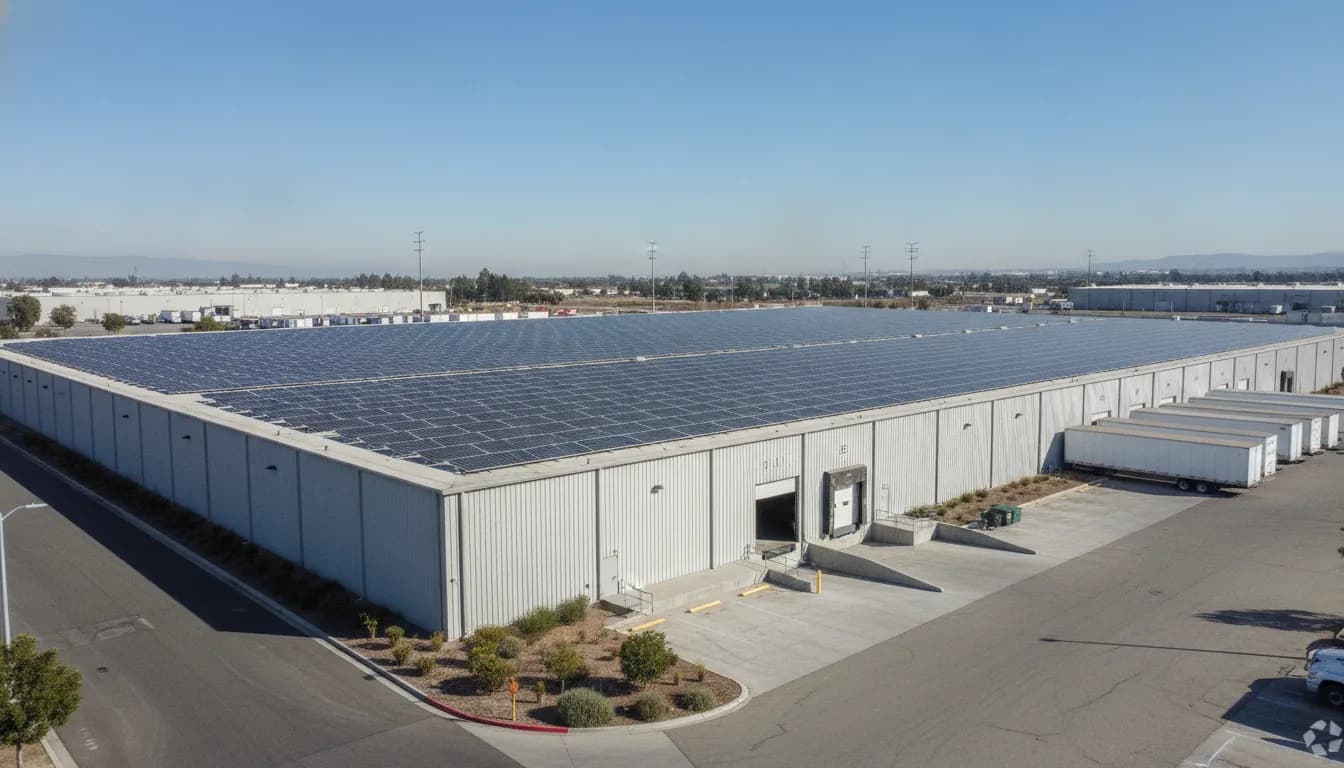
But there's a solution that doesn't require waiting years or relocating your entire operation. Your massive commercial roof can become your power plant. With scalable solar systems, you can maximize your roof space and get the power upgrade you need—on your timeline, not the utility's.
Get a free quote for your home →The Capacity Crisis: What's Really Happening
California's electrical grid is under unprecedented strain. Here's what's happening behind the scenes:
1. Exploding Demand, Limited Supply
The state is experiencing a perfect storm of electricity demand:
- Electric vehicle adoption: Millions of new EVs charging daily
- AI data centers: Massive facilities consuming as much power as small cities
- Electrification mandates: Gas equipment being replaced with electric
- Population growth: More businesses, more homes, more demand
- Industrial expansion: Manufacturing and production facilities scaling up
Meanwhile, the grid infrastructure is aging and new generation capacity takes 5-10 years to build. The result: Demand is growing faster than supply can keep up.
2. Utility Infrastructure Limitations
When you request additional power capacity, here's what PG&E and Edison face:
- Substation capacity limits: Local substations may already be at maximum load
- Transmission line constraints: Power lines can't carry more electricity
- Distribution network bottlenecks: Local infrastructure can't handle increased demand
- Regulatory delays: Permits and approvals can take months or years
- Cost prohibitive upgrades: Infrastructure improvements can cost millions—and you pay for it
The bottom line: Even if the utility wants to help you, they may not be able to. The infrastructure simply isn't there.
 Get a free quote for your home →
Real Stories: When Utilities Say "No" or "Not for Years"
These aren't hypothetical scenarios. This is happening to businesses right now:
Story 1: Manufacturing Facility Expansion Blocked
The Situation:
- Manufacturing company in Orange County needs to add 200 kW of capacity
- New production line requires additional power
- Current service: 500 kW, needs 700 kW total
PG&E's Response:
- "Substation is at capacity. No additional power available."
- "Upgrade would require new substation: 18-24 month timeline, $2.5 million cost (you pay)"
- "Alternative: Wait 3-5 years for regional infrastructure upgrade"
The Business Impact:
- Can't expand production
- Can't fulfill new orders
- Competitors gaining market share
- Revenue opportunity lost: $500,000+ per month
Story 2: Warehouse Can't Add EV Charging
The Situation:
- Distribution warehouse wants to add EV charging for 20 delivery vehicles
- Needs 150 kW additional capacity
- Current service: 400 kW, needs 550 kW total
Edison's Response:
- "Distribution transformer is maxed out."
- "Upgrade requires new transformer and line work: 12-18 months, $150,000 cost"
- "No guarantee of approval—depends on regional capacity"
The Business Impact:
- Can't transition fleet to electric
- Missing sustainability goals
- Higher fuel costs continue
- Competitive disadvantage
Story 3: Data Center Expansion Delayed Indefinitely
The Situation:
- Data center needs to double capacity
- Requires 1 MW additional power
- Current service: 1 MW, needs 2 MW total
PG&E's Response:
- "Regional grid cannot support additional load."
- "No timeline available for infrastructure upgrade."
- "Consider relocating to area with available capacity."
The Business Impact:
- Can't scale operations
- Can't accept new clients
- Forced to consider relocation
- Millions in lost revenue
 Get a free quote for your home →
The Hidden Cost: It's Sometimes Easier to Buy a New Building
This is the reality many business owners face. When utilities can't provide power upgrades, the math becomes stark:
The Relocation Math
Option 1: Wait for Utility Upgrade
- Timeline: 2-5 years (or indefinite)
- Cost: $500,000-$2,500,000+ (you pay for infrastructure)
- Lost revenue: $500,000-$2,000,000+ per year while waiting
- Risk: No guarantee it will happen
- Total cost: $2,000,000-$12,500,000+
Option 2: Relocate to New Building
- Timeline: 6-12 months
- Cost: $1,000,000-$3,000,000 (building purchase/lease + relocation)
- Lost revenue: Minimal (can plan transition)
- Risk: Low (you control the timeline)
- Total cost: $1,000,000-$3,000,000
The Result: Many businesses choose relocation because it's faster, more certain, and sometimes cheaper than waiting for utility upgrades.
But there's a third option that most businesses don't consider—until now.
The Solar Solution: Your Roof Becomes Your Power Plant
Your massive commercial roof is an untapped asset. With scalable solar systems, you can:
- Generate the power you need—exactly when you need it
- Maximize your roof space—every square foot becomes productive
- Scale as you grow—add capacity incrementally
- Get power in 60-90 days—not years
- Control your destiny—no waiting on utilities
How Commercial Solar Solves the Capacity Problem
Here's how it works:
1. Immediate Power Generation
Solar systems produce power during business hours—exactly when you need it most:
- Peak production: 10 AM - 2 PM (peak business hours)
- Extended production: 7 AM - 6 PM with microinverter systems
- On-site generation: Power produced where you use it
- No grid dependency: Reduces draw from utility during peak hours
2. Scalable Systems
Start with what you need now, expand as you grow:
- Phase 1: Install 200 kW to meet immediate needs
- Phase 2: Add 200 kW when you expand (6-12 months later)
- Phase 3: Add another 200 kW as business grows
- Total capacity: 600 kW+ from your roof
Real Example: A 50,000 sq ft warehouse roof can support 400-600 kW of solar capacity. That's enough to power a significant manufacturing operation or eliminate most of your grid dependency.
3. Maximize Roof Space
Modern solar systems are designed to maximize every square foot:
- High-efficiency panels: More power per square foot
- Optimized layouts: Work around HVAC, skylights, and equipment
- Multiple orientations: Capture sun from all angles
- Microinverter technology: Each panel optimized individually
Result: You can generate 300-500 kW from a typical 40,000-60,000 sq ft commercial roof. That's enough to power a manufacturing facility, warehouse, or data center.
4. Power When You Need It Most
Commercial solar has a unique advantage: it produces maximum power during business hours.
- Manufacturing runs 7 AM - 5 PM? Solar produces 7 AM - 6 PM
- Warehouse operates 6 AM - 8 PM? Solar produces 6:30 AM - 7:30 PM
- Data center runs 24/7? Solar reduces peak-hour grid purchases
With microinverter systems, you get extended production hours—panels start producing earlier in the morning and continue later into the evening. This means more power during your operational hours.
Real-World Solution: Manufacturing Facility Gets 300 kW Upgrade
Let's look at how this actually works:
The Challenge
- Manufacturing facility in Anaheim
- Current service: 500 kW
- Needs: 800 kW total (300 kW additional)
- PG&E response: "No capacity available. 2-3 year wait, $1.2 million cost"
The Solar Solution
- Roof size: 45,000 sq ft
- Solar system: 300 kW (750 panels)
- System cost: $900,000
- After 30% ITC: $630,000
- After depreciation: Net cost ~$200,000
- Timeline: 60-90 days from contract to operation
The Results
- Power upgrade achieved: 300 kW additional capacity
- Timeline: 60-90 days vs. 2-3 years
- Cost: $200,000 net vs. $1,200,000+
- Annual electricity savings: $108,000+ (at $0.36/kWh)
- Payback: Less than 2 years
- Business impact: Can expand production immediately
The Bottom Line: The business got the power upgrade it needed in 90 days, at 1/6th the cost, with ongoing savings and tax benefits. Plus, they own the system and control their power generation.
Why Solar Works When Utilities Can't
Solar solves the capacity crisis in ways utilities can't:
1. Speed: 60-90 Days vs. Years
- Solar: 60-90 days from contract to operation
- Utility upgrade: 2-5 years (or indefinite)
- Difference: You can expand your business this quarter, not in 3 years
2. Cost: You Own It, Not the Utility
- Solar: You own the system, get tax benefits, and save on electricity
- Utility upgrade: You pay for infrastructure you don't own, no tax benefits, rates still increase
- Difference: Solar is an investment. Utility upgrades are just a cost.
3. Control: You Decide, Not the Utility
- Solar: You control when to install, how much to install, when to expand
- Utility upgrade: Utility controls timeline, capacity, and approval
- Difference: You're in the driver's seat, not waiting on someone else's schedule
4. Scalability: Grow as You Grow
- Solar: Start with 200 kW, add 200 kW next year, add more as needed
- Utility upgrade: All-or-nothing infrastructure upgrade
- Difference: Solar matches your business growth. Utility upgrades are massive, one-time projects.
5. Reliability: Power When You Need It
- Solar: Produces power during business hours, reduces peak demand charges
- Utility upgrade: Still subject to grid outages, rate increases, demand charges
- Difference: Solar gives you on-site generation. Utility upgrades just give you more grid dependency.
Maximizing Your Roof Space: The Numbers That Matter
Your commercial roof is a valuable asset. Here's what it can generate:
Typical Commercial Roof Capacities
| Roof Size | Solar Capacity | Annual Production | Power Equivalent |
|---|---|---|---|
| 20,000 sq ft | 150-200 kW | 225,000-300,000 kWh | Small manufacturing facility |
| 40,000 sq ft | 300-400 kW | 450,000-600,000 kWh | Medium manufacturing facility |
| 60,000 sq ft | 450-600 kW | 675,000-900,000 kWh | Large manufacturing facility |
| 100,000 sq ft | 750-1,000 kW | 1,125,000-1,500,000 kWh | Major industrial facility |
Key Point: A typical 40,000-60,000 sq ft commercial roof can generate 300-500 kW of power. That's enough to power a significant manufacturing operation or eliminate most of your grid dependency during business hours.
The Financial Case: Solar vs. Utility Upgrade vs. Relocation
Let's compare all three options for a business needing 300 kW additional capacity:
Option 1: Wait for Utility Upgrade
- Timeline: 2-5 years
- Upfront cost: $1,200,000 (you pay for infrastructure)
- Lost revenue (3 years): $1,500,000 (can't expand)
- Ongoing costs: Higher electricity rates continue
- Total 5-year cost: $2,700,000+
- Risk: No guarantee it happens
Option 2: Relocate to New Building
- Timeline: 6-12 months
- Upfront cost: $2,000,000 (building + relocation)
- Lost revenue: $200,000 (during transition)
- Ongoing costs: Higher electricity rates continue
- Total 5-year cost: $2,200,000+
- Risk: Business disruption, employee retention
Option 3: Solar Power Upgrade
- Timeline: 60-90 days
- Upfront cost: $900,000
- After 30% ITC: $630,000
- After depreciation (Year 1): Net cost ~$200,000
- Lost revenue: $0 (can expand immediately)
- Ongoing savings: $108,000/year (electricity savings)
- Total 5-year cost: -$340,000 (you're ahead by Year 2)
- Risk: Low (proven technology, fast installation)
The Winner: Solar not only solves the capacity problem faster and cheaper, but it actually makes money. By Year 2, you've recovered your investment and are generating positive cash flow. By Year 5, you're $340,000 ahead—while the other options cost you $2-3 million.
Scalable Systems: Start Small, Grow as Needed
One of the biggest advantages of solar: you don't have to install everything at once.
Phase 1: Immediate Needs (60-90 Days)
- Install 200 kW to meet current expansion needs
- Get power upgrade immediately
- Start saving on electricity costs
- Begin receiving tax benefits
Phase 2: Future Expansion (6-12 Months Later)
- Add another 200 kW as business grows
- Seamless integration with existing system
- Continue scaling capacity
- Additional tax benefits
Phase 3: Maximum Capacity (As Needed)
- Add final 200 kW to maximize roof space
- Total capacity: 600 kW from your roof
- Maximum power generation
- Maximum savings and tax benefits
Real Example: A manufacturing facility starts with 200 kW to power a new production line. Six months later, they add 200 kW for another line. A year after that, they add the final 200 kW to maximize roof space. Total: 600 kW of on-site power generation, installed incrementally as the business grows.
Why Manufacturing and High-Power Users Benefit Most
Manufacturing facilities and high-power businesses are uniquely positioned to benefit from solar capacity upgrades:
1. High Electricity Consumption
- Manufacturing uses massive amounts of power
- High consumption = high savings potential
- Faster payback periods (often 2-3 years)
- Maximum tax benefits
2. Large Roof Space
- Manufacturing facilities typically have massive roofs
- 40,000-100,000+ sq ft roofs common
- Can support 300-1,000+ kW systems
- Maximum power generation potential
4. Peak Hour Alignment
- Manufacturing runs during daylight hours
- Solar produces maximum power during business hours
- Perfect alignment of production and consumption
- Maximum value from every kWh generated
5. Demand Charge Reduction
- High-power users face expensive demand charges
- Solar reduces peak grid consumption
- Lowers demand charges significantly
- Additional savings beyond electricity generation
The Tax Benefits: Making Solar Even More Attractive
Commercial solar comes with powerful tax incentives that make it even more cost-effective:
30% Investment Tax Credit (ITC)
- 30% of system cost as direct tax credit
- Reduces net cost immediately
- Available in Year 1
Accelerated Depreciation
- 60% bonus depreciation in Year 1
- MACRS depreciation over 5 years
- Can write off 60-80% of cost in Year 1
- Massive tax savings
Real Example: $900,000 System
- System cost: $900,000
- ITC (30%): $270,000 tax credit
- Net cost after ITC: $630,000
- Bonus depreciation (60%): $378,000 × 25% tax rate = $94,500 tax savings
- MACRS Year 1: $50,400 × 25% = $12,600 tax savings
- Total Year 1 tax benefits: $377,100
- Net cost after Year 1: $252,900
Result: A $900,000 system costs you $252,900 net after Year 1 tax benefits. That's 72% cost recovery in the first year alone.
Getting Started: Your Path to Power Independence
If you're facing a capacity constraint, here's how to get started:
Step 1: Assess Your Situation
- How much additional power do you need?
- What's your current roof size and condition?
- What's your timeline for expansion?
- What has the utility told you?
Step 2: Get a Roof Assessment
- Evaluate roof space and capacity
- Design optimal system layout
- Calculate power generation potential
- Determine system size needed
Step 3: Financial Analysis
- Compare solar cost vs. utility upgrade cost
- Calculate tax benefits and payback
- Model electricity savings
- Show ROI and cash flow impact
Step 4: Installation Timeline
- Contract to operation: 60-90 days
- Permits and approvals: 30-45 days
- Installation: 2-4 weeks
- Utility interconnection: 1-2 weeks
The Bottom Line: Don't Wait for Utilities That Can't Deliver
If PG&E or Edison can't provide the power you need, you have options:
- Wait years for utility upgrades (if they ever happen)
- Relocate to a new building (massive cost and disruption)
- Install solar and get power in 60-90 days (fast, cost-effective, you own it)
For manufacturing facilities and high-power businesses, commercial solar isn't just an alternative—it's often the only viable solution that delivers power when you need it, at a cost you can control, with benefits that compound over time. Learn about fast payback for businesses.
Your massive commercial roof is an untapped asset. With scalable solar systems, you can maximize that space and get the power upgrade you need—on your timeline, not the utility's. Consider ground-mount options for additional capacity.
The capacity crisis is real. But so is the solution. Your roof can become your power plant. And you can have it operational in 60-90 days, not years.
Ready to explore how solar can solve your capacity constraints? Get a free assessment that evaluates your roof space, calculates your power generation potential, and shows you exactly how commercial solar can deliver the power upgrade you need—when you need it. Speak with our experts to discuss your business needs.
Related Articles
Commercial Solar ROI: Demand Charges, ITC & MACRS Explained
Commercial solar ROI for Orange County businesses: demand charge math, tax stack, PPA vs cash, and case study framework.
Read More →Cold Storage Solar ROI: Refrigerated Warehouse Savings
Cold storage solar ROI: refrigeration load profiles, demand charge reduction, and sample payback for OC warehouses.
Read More →100% Solar Payback in Year 1: How Businesses Achieve Instant ROI with ITC, Depreciation, and Tenant Billing
Commercial solar can achieve 100%+ payback in Year 1 for businesses. Learn how the 30% ITC, bonus depreciation, MACRS, and tenant billing create instant ROI—real examples and calculations showing how businesses recover their entire investment in the first year.
Read More →